Healing the Ancestral Hauntings of the Archetypal Mother
A Tale of Two Feeling Types
Download or listen to this article
Robinson, L. Ellen, October 18, 2023
 My mother is a ghost now. She died the last day of 2016. She was the person nearest and dearest to me for much of my life, yet it seemed we never quite understood and accepted each other unconditionally. She haunts me as an unfulfilled spirit when I have anxious thoughts, or fearful premonitions, or self-admonition, but also in old sayings, endearing quirks, and the names of the flowers and trees. And she inhabits my dreams, mostly as an unhappy child. James Hollis (2009) wrote of psychological ghosts: “Do we not all serve spectral presences, primal complexes, ghostly admonitions, ephemera which bind us to our past? … Does not such unconscious bondage reduce the scope of the life we might otherwise be living?” (p. 24). The shrine of the past is these regrets, wounds, and frustrations, and the bondage is the web of habitually activated complexes when we cannot see the archetypal energy rattling chains for recognition. The scope of life is limited by the walls we erect against the unconscious psyche that guides us to meaning.
Psychological type helped me understand my children and find my way out of an unsuitable profession and into academia. The dynamics of John Beebe’s (2005) eight-function model of psychological type, which elaborated on Jung’s framework, helps me quiet the dis-ease I feel around my mother’s death. Jung himself struggled with the laments of the dead, which are chronicled in The Red Book (2009). Jung’s confrontation with the unconscious was his own coming to terms with the personal and collective ancestors (Jung & Jaffe, 1961/1989). His theories of psychological type grew out of those years of facing the unconscious, including, and especially, the unquiet dead (Jung & Shamdasani, 2009). James Hillman pointed out in Lament of the Dead, “The questions that occupy you have been handed to you. That’s one of Jung’s main thoughts, that one” (p. 26). Though my mother has died, I hope to confront what is still unconscious about our relationship and to answer some of the questions left for me in service to the past and the future of my own mother-child relationships.
The story of my relationship with my mother is warm, imperfect, and unbroken. Never a week went by that she and I did not talk, and more often we talked daily. As an adult, I lived three hours’ drive away but visited her frequently with my children. Yet no matter how much we sincerely looked forward to seeing each other, we felt an underlying tension in each other’s presence. I sensed that she wished I was different than I am, and if I am honest with myself, I often wanted her to be different than she was as well. If Jung (1989) associated the word “woman” with the word “unreliable” because of his childhood experiences with his mother (p. 29), then my word association with “mother” would be “worry.” She both worried about every possible future calamity and worried others as if to recruit companions-in-angst. I wonder what word she might associate with me. “Vex,” perhaps? I rarely met her need for reassurance about worries; instead, I dismissed her concerns as overwrought and left her alone at their mercy.
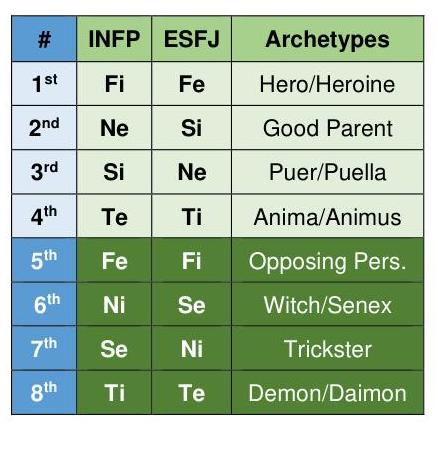 My mother had preferences for ESFJ and mine are for INFP, two personality types that sound convincingly different in the Myers Briggs Type Indicator® (MBTI®) nomenclature. However, Beebe’s eight-function model reveals that our likenesses are in the letters that differ, and our greatest difference, paradoxically, is in the letter “F” for feeling that we share. Feeling is dominant for both of us, but in opposite attitudes. The ESFJ, my mother’s type, extraverts the dominant feeling (Fe) function, meaning “Her personality appears adjusted in relation to external conditions. Her feelings harmonize with objective situations and general values” (Jung, 1921/1971, ¶ 597). I introvert my dominant feeling function (Fi), meaning my “own viewpoint [is] the arbiter of reality and define[s] externals in terms of it” (Thomson, 1998, p. 40). For my mother, reality is dependent on others outside herself and their reactions to the world. For me, the world is brought inside before it is experienced as reality. This difference of attitude sets up a fundamental heroic clash in how to view the world. Is the world to be externally experienced and harmonized with, as for a dominant extraverted feeler (Fe)? Or is the world made real when brought inside for evaluation as for a dominant introverted feeler (Fi)?
A Natural Archetypal Child-Parent Configuration
In contrast to the opposite-attitude feeling functions, our middle functions are in the same attitude (extraverted intuition, Ne, and introverted sensation, Si), but their positions are swapped. Marie Louise von Franz (1971) wrote, “It was not our middle functions that got us into trouble, but our dominant ones” (p. 55). Enough consciousness lies around these middle functions for them to be pliable and for us to realize them in operation, but they are not so attached to the dominant functioning or the inferior functioning that they are difficult to wield, either from too much libido (psychic energy) or not enough. According to the Beebe model, our comparable middle functions set up an interesting archetypal interaction, which was played out in our relationship.
 My mother and I connected through a shared love of literature and history (Ne); we also bonded around the introverted sensing (Si) function—we paid attention to internal symptoms, enthusiastically remembered family stories, and keenly valued sentimental items, and we had played with similar childhood toys. Through introverted sensing, we both preferred to experience objects for their inner effects on us. Lenore Thomson (1998) wrote:
When we use Introverted Sensation, we don’t adjust to our surface perceptions. We package them and take them with us—in the form of facts, numbers, signs, and memories. …We stabilize our immediate sense impressions by integrating them with the ones we remember and care about. (p. 169)
Introverted sensing is in the archetypal parent position for my mother, according to Beebe’s model (2005), and she is the actual parent to me. Shumate (2021) wrote that auxiliary introverted sensing “creates an aesthetically pleasing environment filled with photos and mementos” (p. 190). Introverted sensing is in the archetypal child position for me, and I am her actual child. According to Shumate (2021), individuals with tertiary introverted sensation enjoy “being at home and making it a comfortable environment” (p. 190). Indeed, my mother’s home was aesthetically pleasing and full of family photos and decorated with the help of an interior designer. Many of her mementos now adorn my house, which is more comfortable than aesthetically pleasing. I am the one child in the family who can identify the people in our family’s old black and white photos and who knows the facts about how they are related and what happened to each person.
The year after my mother’s death, I went through all her photos and letters and sentimental savings, which filled the attic. Shumate (2021) said that when introverted sensation occupies the auxiliary or parent position, the individual “often acts as the institutional memory for an organization” (p. 190). She had served in the role of the archetypal parent, and I intended to be the dutiful archetypal child to maintain the family’s institutional memory. I was surprised to find snippets of fabric, postcards, autographs, scrapbooks, lockets with photos, and a huge collection of fancy paper dolls that she had never shared with me. Perhaps she had not shown me some of these sentimental treasures because types with Si in the archetypal parent position may “feel sad at the passage of time, wishing to freeze it in place” (Shumate, 2021, p. 190). The archetypal mother feels nostalgic for the past and may want to protect the archetypal child from the sad sense of loss the passage of time brings. With a deeper appreciation of psychological types, I can now see that in this shared appreciation of nostalgia, our relationship felt like a harmonic resonance between actual and archetypal mother and between actual and archetypal child because of the location of introverted sensation in our respective psyches. However, for me, the archetypal child sees the past with a sense of wonder, like a personal bedtime tale, because it is supported by my parental extraverted intuition. Pioneering grandparents and wayward uncles are accessible heroes and tricksters. I did not necessarily need protection from sadness.
Both as a child and as an adult, I have experienced the sadness of the past, although I can also enjoy dwelling in that melancholy, corroborating Shumate’s (2021) observation that INFPs “can be temporarily overtaken by sad memories but may enjoy giving in to them” (p. 191). My extraverted intuition enhanced this poignancy and was particularly activated at bedtime. When I was six or seven years old, it hit home that everyone will one day die—including my mother. My immature intuition brought to consciousness this sudden realization that one day my mother would be permanently lost to me. I often sobbed into my pillow, which silenced the sound of my dark secret. Surely it was bad luck to speak such a thing aloud, so I never sought comfort. My reticence was probably due to activation of my introverted intuition (Ni) in the sixth position of senex/witch, which “may fear or flee the mystical, viewing it as superstition” (Shumate, 2021, p. 202). I also grieved alone as an adult when my children were young. Mourning another day of their childhood gone felt like an act of contrition. In typical Si form, my tears recognized that I had not fully appreciated every fleeting, golden moment, and now those moments were gone. And one day the days would run out. Now they all have. My mother is dead, and my children are grown and have moved away.
My mother and I shared conscious extraverted intuition but did not use it as synergistically as we used the Si function because it fills my archetypal parent position but is in her archetypal child position, and therefore would encourage the child to parent the parent. Intuition is a function that seems to tap more directly into material from the unconscious. “In intuition a content presents itself whole and complete, without our being able to explain or discover how this content came into existence” (Jung, 1921/1971, ¶ 770). My extraverted intuition is a favored function, aiding my introverted feeling (Fi). I extravert and engage with the world through this archetypal parent position. When I archetypally act as parent, my more confident intuition overpowers her more childlike apprehensions. Thomson (1998) wrote:
With Extraverted Intuition, we’re focused on the future. Once we’ve grasped a whole pattern, we can envision options that don’t yet exist. Indeed, one of the drawbacks of Intuition is that it conjures up a future before we know very much about the present. (p. 193)
 These possibilities, lacking the fleshed-in details, unsettled my mother’s need for security, which is important to those with parental introverted sensing like the ESFJ. My parenting of my mother had a negative effect on her worries. My extraverted intuition rapidly generated possibilities that overwhelmed her. Her intuition was more childlike and less conscious than mine, and her perception of the possibilities skewed toward negativity, mainly fear. Her extraverted intuition teamed up with her extraverted feeling to give voice to many worries. I was always relieved when I talked to her if I was not the subject of her worry because she was always going to be worried about something and be pushing someone to do something about it.
I imagine we both had inner pep talks from our heroic dominant functions before spending time together. I would make myself promise not to bristle when she pushed me to worry along with her about something that was out of our control. I imagine she told herself she was not going to tell me what to do. Our resolves seldom lasted more than five minutes. “The theme of Psychological Types is that the one-sided development of our primary function, while it initially advances the ego’s goal, eventually triggers an enantiodromic reversal such that we bring about the opposite of what we intend” (Shumate, 2021, p. 21). As feeling types we could value our time with each other, but because we operated out of each other’s shadows, we brought about the opposite of what we intended. We saw in each other our own shadows, the parts of ourselves we did not want to admit. Von Franz (1971) confirmed the challenge:
It would be most difficult for an introverted feeling type to understand an extraverted feeling type. There one feels that one does not know how the wheels go round in that person’s head; one cannot feel one’s way into it. Such people remain to a great extent a puzzle and are very difficult to understand spontaneously. (p. 55)
Von Franz pointed out that understanding cannot be approached with feeling, my dominant function. Understanding “how the wheels go round” is a product of thinking. Therefore, if I am to understand my mother’s extraverted feeling, I will most likely do so with my inferior extraverted thinking (Te), which, although difficult to access and nearly inaccessible to conscious control, is the thinking function-attitude most available to consciousness for me. The introverted form of thinking (Ti) is in the archetypal demonic/daimonic eighth position for my type, and therefore I am more likely to make a mess of things than solve any problems with it. If I am to receive a Ti conceptual insight, it will have to come to me indirectly, through a dream or intuition, perhaps. Writing about trying to understand my mother may be the best approach I have available.
Inner Harmony vs. Outer Harmony Leads to Cacophony
Both attitudes of feeling seek harmony, but extraverted feeling seeks harmony between people and events in the outer world while introverted feeling seeks harmony with the inner world, which means attaining a sense of inner peace by living in alignment with personal values. Introverted and extraverted feeling can be compatible as long as inner values and societal standards are not in conflict, but they often are. Of the “normal” extraverted person of all functions, Jung (1921/1971) wrote:
He owes his normality. . . . to his ability to fit into existing conditions with comparative ease. His requirements are limited to. . . what is expected of him, and [he] refrains from all innovations that are not entirely self-evident or that in any way exceed the expectations of those around him. (¶ 564)
 A preference for extraverted feeling brings a tendency to align one’s values with the collective norms. My mother found it much easier and much more desirable to meet expectations and to fit into existing conditions and to avoid novel responses to situations. She thought it was contrary and confounding of me when I wanted to go my own way. I was the most flexible of her children, however, so she always expected me to be the one to acquiesce to the more strong-minded family members. Thomson (1998) wrote of introverted feeling: “Decisions made on this basis are frequently misunderstood as a product of emotion or a deliberate rejection of structural authority” (p. 342). My family perceived the way I operated in the world as a rejection of their authority. My mother trusted the men in my family because they are thinking types, and they favored using that judging function; thus, they were quicker to exert structural authority, which provides safety. My personal extraverted intuition tended to “emphasize variation and multiple options” (Thomson, 1998, p. 58), which made me hard to pin down and led my mother to evaluate me as careless. Her judgment may have been a projection on her part, a function of her anxious nature. Carelessness is the shadow of attentiveness, and dominant introverted feeling may seem inattentive to externals seen by a dominant extravert like my mother. An important realization in the healing process for me was that our conflict was not so much about a flaw in me as it was a fear of hers.
Moral choices are the facility of introverted feeling, and they are individually determined. My mother’s insistence that I compromise values and acquiesce to the men in my family was a big ask of me that my mother saw as inconsequential. Acceding to expectations without contemplation meant that I sacrificed values so that her external harmony could be maintained. Conformity is sometimes necessary, but I could not acquiesce by default without feeling that something intrinsic to my being had been violated. According to Jung (1921/1971):
Each type of thinking senses the other as an encroachment on its own province, and hence a sort of shadow effect is produced, each revealing to the other its least favourable aspect. Introverted thinking then appears as something quite arbitrary, while extraverted thinking seems dull and banal. Thus, the two orientations are incessantly at war. (p. 345)
Though this passage cites thinking, the projection of shadow takes place with the opposite attitudes of feeling, sensation, and intuition as well. To my mother, I acted arbitrarily. To me, her actions were dull and banal. The mother-daughter psychological complex is already, well, complex, but more detailed examination reveals how our dominant feeling functions in opposite attitudes meant we acted as projections of each other’s unconscious shadows.
This shadow effect in our typologies was especially profound because our favored feeling functions triggered each other’s opposing personality complex in the Beebe (2005) model. As the opposing personality function resides just below consciousness, it is positioned to frequently disturb consciousness. I was unconsciously being asked by her to undermine and act contrary to my dominant Fi values of inner authenticity. Yet, by disregarding her desire to harmonize with the outer world, I was unconsciously failing to meet, and even undermining, her dominant Fe values. And at times, by fighting her badgering, I felt a great amount of guilt after the fact, another source of grief in the night. I was punished by my parents, and, because I did not understand that the source of my contrariness was a deep desire to be an individual, I punished myself. I told myself that I was just a bad girl. As an adult, I would look back on many of our interactions and feel like a bad daughter for not acquiescing to or catering to her fears. The beauty of this depth work using my extraverted thinking function by writing is that I did not realize that very thing until just now as my fingers typed the words. I was not being bad. I was trying to be me. The objective psyche has been saying as much all along. It is not a matter of bad or good, but a matter of authenticity.
The eight-function model makes the shadow easier to peer into and makes what one sees there less deniable. I may feel that following social convention is an inferior way of living one’s life, but if I am objective, it is not wholly wrong. The objective psyche does not judge. It reveals. If I do not acknowledge that extraverted feeling offers a worthwhile way to move through life at times, then I am rejecting a chance to increase consciousness. As Hollis (2009) said, I “reduce the scope of the life [I] might otherwise be living” (p. 24).
The Last Week of Her Life
The trickster’s fingerprints are all over the events around my mother’s death. To host Christmas in 2016, my partner and I rented a cabin and decorated it from Christmas tree to Christmas ham. Surprisingly, my mother acquiesced to attending. It was her first Christmas without my father, and she did not have him to shield her from things she did not want to do. It was clear to me, and only me, that she dutifully endured the experience with little joy and much worry. Everyone asked after her death, “Aren’t you glad you had that special cabin Christmas with your mother?” No. I would have given anything to have let her stay home and to have celebrated there with her. But, in answer to the question, I harmonized and just smiled.
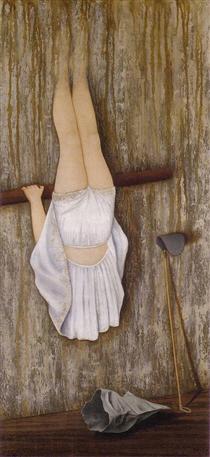 Christmas Eve night, everyone played a silly game while she sat alone in another part of the big room, like a child parked in front of a television to keep her occupied. She watched a favorite movie, It’s a Wonderful Life. At the time for her, it was not a wonderful life. Her congestive heart failure kept her activity at a minimal level. Her hearing could not be further improved, and she had gastrointestinal issues that led her to decline most social invitations. I remember her catching my eye when the character Clarence said her favorite line, “Every time a bell rings, an angel gets his wings.” But I felt sad that she sat away from us. I think her extraverted feeling was all worn out. A common stressor for the ESFJ type is “finding people to love” (Shumate, 2021, p. 247). So many of her people had died in the past five years, and my dad had died eight months earlier. I would give anything to go back and sit with her and watch that movie.
In the week after Christmas, I spent a couple of more days with her at her home. We made our customary rounds of our hometown, Gainesville, GA, but she did not have the energy to get out of the car, not even to “walk through Belk,” which we had done most every time I visited for nearly 30 years. As we drove home, it was getting dark, and I cruised very slowly through the streets of her neighborhood so she could see everyone’s house decorated for Christmas, for what would be one last time. As she took in the colored lights through the passenger window, she recounted a dream from the week before—the first dream she could remember in years. It featured my father. He was younger and healthy and “holding court” as she called it when he got into storytelling mode. She assumed he was talking to his siblings, who are also deceased, because they were the audience that encouraged him to take center stage. “It was so real,” she said, wistfully. She knew I participated in a dream group, and I imagine she was asking for an interpretation. She seemed to know there might be a greater meaning to it. I would later study end-of-life dreams. Kerr & Donnelly, et al (2014) wrote: “Nearly all participants indicated they felt real. The most common dreams/visions included deceased friends/relatives,” and the appearance of the deceased was significantly comforting (p. 296). Learning this has been a comfort to me, but at the time I felt dis-ease, perhaps a premonitory warning.
The next day, Wednesday, I left for home, and she went to the beauty parlor for a permanent wave in her hair. On Thursday, however, she called my brother, and said she needed to go to the hospital. She felt weak, as if she was fading away. On Friday, she suffered a grueling series of tests. I cannot imagine how miserable she was without my father to protect her and in the company of my ESTJ brother who had often been dismissive and impatient with her complaints of nebulous symptoms. Because she felt so exhausted, she pleaded with him to not make her talk to anyone on the phone. She asked that he report all information to my sister and me, which he dutifully did. When my sister and I asked if we should come to the hospital (she lives on the west coast), the doctor told us no, “It is not to that point yet,” meaning the heart condition, in his opinion, was not imminently terminal. The test results had only showed a slight worsening of the heart strength, and he would release her to go home.
But New Year’s Eve was the next day, and she had no hired help scheduled. My brother was hosting an annual New Year’s Eve party for close friends and their kids that were now mostly grown. This year’s annual theme was Hawaiian—a December luau in Georgia. My brother likes to go big, and was roasting an entire pig in a huge pit he had dug in the back yard. My mother very much wanted to stay in the hospital. Her fearful Ne archetypal eternal child was afraid, and the Si parent wanted reassurance of security. Doctors get reprimanded these days if their discharged patients return to the hospital before a prescribed number of days, so he agreed to keep her over the weekend.
On New Year’s Eve morning, my brother called me from the hospital room and told me she was better. I told him I planned to come to Gainesville on Monday to stay with her a long while after she went home. An hour later, I decided I would call and talk to her myself, despite her previous biddings. She answered, but her voice sounded very weak and child-like. She told me the doctor said she was going to have to step up caring for herself when she got home; there was nothing more they could do with medicine. “That doctor scared me to death,” she said, but the details were fuzzy. Citing what ESFJ types said of themselves, Haas and Hunziker (2006) reported: “If someone is displeased with me, it bothers me so much that I can’t hear what the person is saying” (p. 98). The doctor had been using extraverted thinking to direct and instruct her, but an ESFJ’s response to Te might be to “view directions as a veiled critique of oneself” (Shumate, 2021, p.218). Her inner child had been scolded and would have to take care of herself. The doctor presented to her as a trickster image perhaps—a doctor who was neither parent nor savior. Introverted intuition is in the trickster position for her, where it may cause her to “deliberately misinterpret an unwelcome communication” (Shumate, 2021, p. 203).
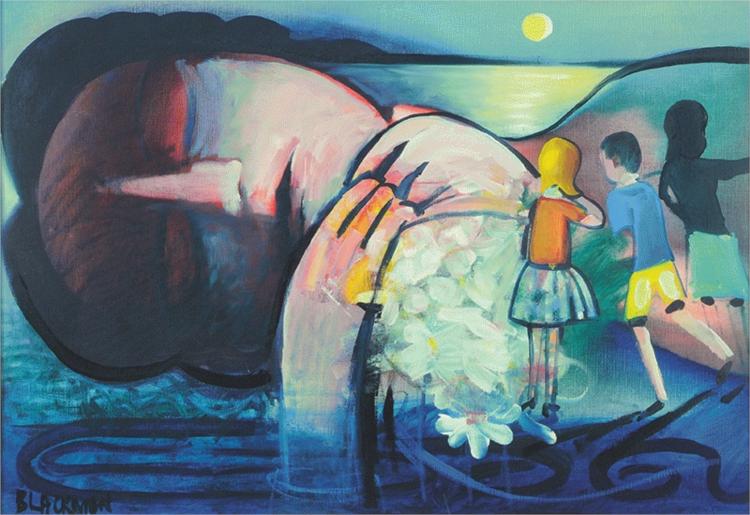 I tried to reassure her that we would help her, and I would be there when she went home. As we signed off the call, I thought, “I love you,” but I did not say the words. Despite being feeling types, she and I never said those words. What had stopped me seems absurd. I thought saying the words suddenly now might scare her and make her fear her condition was worse than it was. As it turned out, her condition could not have been more serious. Two hours later my brother called. That doctor that had “scared her to death” had returned for morning rounds. While he was talking to her, she had slumped over, and the code team was at that moment actively attempting to revive her. He had rushed back to the hospital and now had my sister and me on the phone outside her room. The medical team wanted authorization to stop the resuscitation. We all three gave the permission.
My brother decided to still have the New Year’s Eve gathering, as it would serve as a wake. How bizarre it was to exhume a pig from a pit when my mother was headed for a grave, but if anyone else thought so, too, they refrained from commenting. My memory of the evening feels dreamy. Old friends arrived to listen, hug, and cry with us, and we swapped stories that reminded us all we share this journey of life. Most had known our mother. Wes took me aside and tearfully told me that he had gone in to see our mother just after her death. His wife Jill had held her hand and told her lifeless body that she had been a better mother to her than her own mother had ever been. Jill and I had both withheld these words of love from an ESFJ to whom it would have meant the world. My brother and I hugged long and warmly as we had never done before in our lives. We regularly tell each other, “I love you,” these days.
Years later, at a dream group, I told the story of my mother’s death as a waking dream, and everyone listened respectfully. The leader, a long-time mentor of mine, gently asked, “Ahm, would your mother, perhaps, have been amused that when she died Wes had a whole pig roasting in the ground?” There had been enough distance to ask—and to laugh. I thought about it for a moment. “No, but my father would have,” I replied. I could hear him cackling. And I thought of her dream of him holding court with his siblings. What a story he could have made of the whole event.
An additional trickster component preceded her death. I had quit my pharmacist job four weeks earlier with the intent to leave the profession for good. I planned to spend 2017 living on the proceeds of a house sale the previous year, figuring out what came next, and spending more time with my newly widowed mother. Now, instead of spending time with my living mother, I spent the year going through her Si-inspired collection of papers, photos, and belongings. I took care of her in the way that we got along best. She left me enough money to leave the normal path forever and align with my calling by enrolling in a depth psychology program at Pacifica Graduate Institute, where I am now a student. Would she approve of my path? Not entirely. The path would “exceed the expectations of those around her” (Jung, 1921/1971, ¶ 564) and be “too much” and impractical without a goal. I am sure she would be flattered (Fe) to hear of this article, but afraid of what I might say about her (Ne). She would also have a few corrections to my memory of things (Si).
Saying the Words
Earlier this year I dreamed of my mother. The setting was shadowy. She wore a 19th-century style white cotton gown. She was lying on the cold floor kicking like a worn-out child at the end of a futile tantrum. I scooped her up from behind her back and under her knees to cradle her to my chest like a baby. I rocked her in my arms. “Oh, the person I love most in the world,” I cooed, and she quieted. It felt very real. I hope she heard those words I spoke from my unconscious to her unconscious, through the collective unconscious. When I used to cry at night as a child, that had been the truth. She had been the whole world to me, and I had never again loved quite like that. I think it would have given her a lot of peace to know how much she had meant to me. Jung (1954/1968) described the archetypal mother as the source of growth:
This is the mother-love which is one of the most moving and unforgettable memories of our lives, the mysterious root of all growth and change; the love that means homecoming, shelter, and the long silence from which everything begins and in which everything ends. (¶ 172)
Her mother-love is still moving me to seek inner harmony.
 William Faulkner (1954/2012) once said, “The past is never dead. It’s not even past” (p. 73), to which James Hollis (2013) added, “And what we resist will persist—as haunting” (p. 46). Using Beebe’s eight-function model to process my mother’s death and interpret my dream has brought me yet again to the realization that so much of life is in the unconscious. James Hillman (2013) in Lament of the Dead speculated of Jung’s confrontation with the unconscious in the Red Book. Hillman wrote, “What goes on in myself, the rainmaker, only matters if it is connected to the rain” (p. 150). The psychological work is not only about my mother and me but also about the archetypal mother, our culture, and my children after me. It is about finding consciousness around psychological systems and acknowledging what moves unconsciously. It is also about decentering the small self. I am connected to the collective archetypal realm and the repository of human good and evil and wisdom—the unconscious. Realizing that my little self is not the center of my experience has relativized me and taken some of the pressure off of the way my life is turning out. What is unconscious is what connects me to the collective. Had my mother and I had a perfectly harmonious personality connection, there would be nothing to dig up, nothing to sift through, nothing to drag through the trap door from the unconscious. “Then turn to the dead, listen to their lament and accept them with love” (Jung, 2009, p. 297).
References
Beebe, J. (2005). Evolving the eight-function model. Bulletin of Psychological Type, 28(4), 34-39.
Faulkner, W. (2012). Requiem for a nun. Vintage International. (Original work published 1954)
Haas, L., & Hunziker, M. (2006). Building blocks of personality type: A guide to using the eight-process model of personality type; Jung’s mental processes (1st ed.). Unite Business Press.
Hillman, J., & Shamdasani, S. (2013). Lament of the dead: Psychology after Jung’s Red Book (First edition). W.W. Norton & Company.
Hollis, J. (2013). Hauntings: Dispelling the ghosts who run our lives. Chiron Publications.
Jung, C. G. (1921/1971). Psychological types (R. F. C. Hull, Trans.). H. Read et al. (Eds.), The collected works of C. G. Jung (Vol. 6) (pp. 408-486). Princeton University Press.
Jung, C. G. (1931/1954). Introduction to “Wickes’s Analyse der Kinderseele” (R. F. C. Hull, Trans.). In H. Read et al. (Eds.), The collected works of C. G. Jung (Vol. 17). Development of personality (pp. 37-46). Princeton University Press. https://doi.org/10.1515/9781400850839-004
Jung, C. G. (1954/1968). Archetypes of the collective unconscious (R. F. C. Hull, Trans.). In H. Read et al. (Eds.), The collected works of C. G. Jung (Vol. 9i). Archetypes and the collective unconscious (2nd ed., pp. 3-41). Princeton University Press. https://doi.org/10.1515/9781400850969.3
Jung, C. G., & Jaffé, A. (1961/1989). Memories, dreams, reflections (Rev. ed). Vintage Books.
Jung, C. G., Shamdasani, S., & Hoerni, U. (2009). The red book: Liber novus (M. Kyburz & J. Peck, Trans.; Reader’s edition). W.W. Norton.
Kerr, C., Donnelly, J., Wright, S., Kuszczak, S., Banas, A., Grant, P. (2014). End-of-life dreams and visions: A longitudinal study of hospice patients’ experiences. Journal of Palliative Medicine, 17(3), 298-303. http://www.liebertpub.com/doi/10.1089 /jpm.2013.0371
Shumate, C. (2021). Projection and personality development via the eight-function model. Routledge.
Thomson, L. (1998). Personality type: An owner’s manual. Shambhala.
Tieger, P. D., & Barron-Tieger, B. (1997). Nurture by nature: Understand your child’s personality type—and become a better parent (1st ed.). Little, Brown.
von Franz, M. L. (1971). The inferior function. Lectures in Jung’s typology. Zurich: Spring.
Images
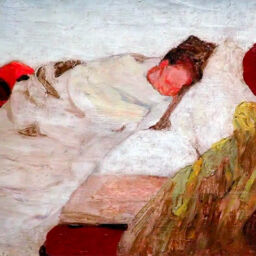
Blackman, C. (n.d.) Sleeping figure. Retrieved from wikiart.org
Bourgeois, L. (2008). The good mother. Retrieved from wikiart.org
Photos From Past To Future. Untitled. Retrieved from unsplash.com
Schultz, J. (n.d.). Untitled. Retrieved from unsplash.com
Strvnge Films. Untitled. Retrieved from unsplash.com
Toyen. (1943). Relache. Retrieved from wikiart.org
Zeid, F. (n.d.). Composition with bones. Retrieved from wikiart.org
Tags